Wednesday, April 21, 2010

Veggies and fruits for your walls

I chuckled when I saw this ad for Tollens paint, but it demonstrates a great way to transform your color preferences and ideas into actual colors for your walls. Gather up those photos you've been setting aside and take them to the paint store for color matching. Or ask your decorative painter to create a special finish based on the fish you've got in your hands!   


I found these veggie images with great color:


and when I saw the recent issue of New York Spaces magazine with the articles on using color in the home, the veggie and fruit colors just leaped out from the paper:


This is a lime plaster sample I created on textured wallpaper.


These fun peach colors...


certainly made their way into this room!


Who can resist these luscious colors?


They were my starting point for this sample of paint and water-based waxes.


Paint and water-based waxes


You can find color ideas everywhere, even in the kitchen!

Monday, April 19, 2010

A fleeting moment

Can you imagine spending many weeks preparing to install a work of art, followed by three weeks of the actual installation in a museum, only to have it painted over once the exhibition closed? On purpose?

 
Credit

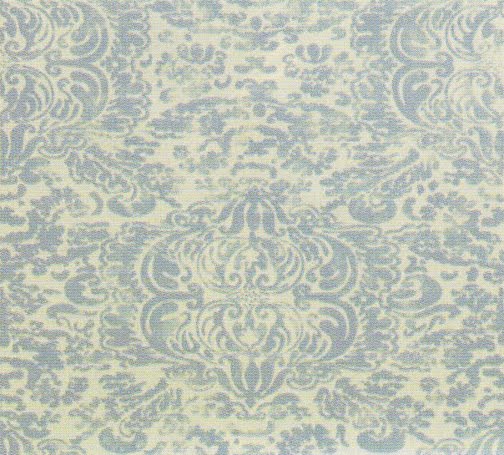
Artist Richard Wright did just that. The Glasgow-based artist won the Turner prize last December in the Tate Britain Museum for his untitled, baroque-style fresco that is created with gold leaf on the entire wall of a gallery. Wright began with the traditional pounce method used in fresco: a cartoon (drawing) was pierced with holes through which chalk was rubbed. Once the cartoon was removed, a "ghost" outline was left. He then sized (applied a special adhesive for the gold leaf) the outlined areas, followed by the application of the gold leaf at just the right time. If the size is too dry, the gold leaf will not adhere. If the size is too "wet", the gold leaf becomes dull. Honestly, how he did it in just three weeks amazes me!
AP photo / Akira Suemori

The fresco, seen from afar, seemed like an abstract design but, up close, the design was composed of landscape images such as clouds and sun. It was said to be mesmerizingly beautiful.

Once the Turner exhibition was finished, the fresco was painted over. Whew! Wright said: " To see a work knowing that it will not last emphasizes that moment of its existence."


France24


Friday, April 16, 2010

Friday Favorites: Aged Patinas

Aged patinas always catch my eye. It's a way to see into the past and appreciate the artistry of people before us. With all of the technology we have at our fingertips, don't you just wonder how they did it one hundred, five hundred, a thousand or two years ago?


Wednesday, April 14, 2010

Rust Patina

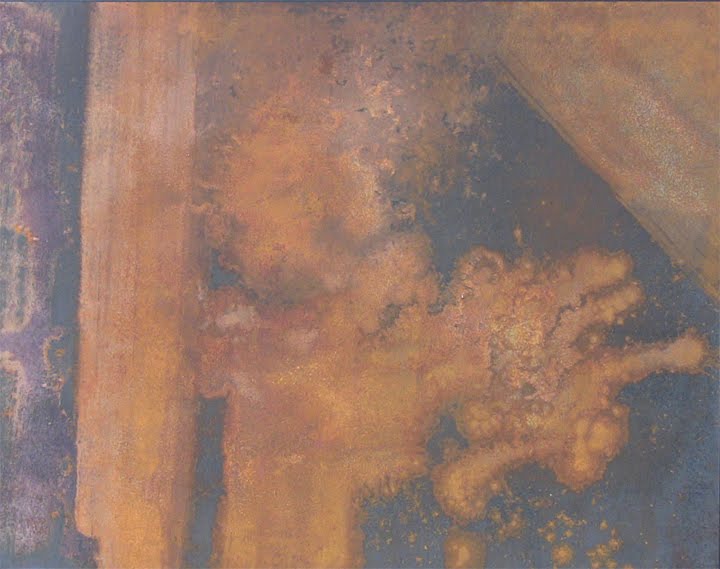
Rust patina, whether it is an applied finish or the actual rusting of iron or steel, is beautiful in its own organic way. It is used in many commercial applications, but is also incorporated into home designs.  The fireplace is created with plates of rusted steel.


 rusted steel fireplace


The following are photos of the first designer gas station in Spain, just outside of Madrid. The curved canopies are made out of corten steel plates and left to rust naturally.  


In order to create a rust patina, there are several items to pay attention to. You must start out with special paints, whether iron, copper or bronze, that are specifically made for this purpose. These water-based, acrylic paints contain a large number of actual metal particles, rather than mica flakes or pigment. The finely ground metal flakes create the look of a true metal surface. One applies a solution that speeds up the natural oxidation of the metal to develop the rust patina.  

When applying the rust solution, careful attention needs to be paid to the product's instructions. Because the solution is usually a mild acid, proper precautions should be taken, such as gloves meant for chemical protection and a face mask.


The next photo is a class sample from the All Aglow: Patinas and Metallics class at my studio.


All Aglow class sample


When I moved into the old warehouse studio, this is one of the doors I needed to finish:


Nice!

After I filled in the texture of the wonderful "wood", I primed and then painted two coats of iron paint. Then the fun began! Several rust patina solutions were applied in every which way. I think the door is touched more than any other door I've seen! One caveat: because the rust patina is a result of a very organic process, it is not possible to accurately predict a specific shade of rust. The results are based on many conditions, such as temperature, humidity and air quality. Samples are definitely a good idea before beginning the final finish.

And, yes, it is sealed. You should definitely seal a rust patina if it is going to be exposed to extreme weather or if folks will come into contact with the finish.
However, do not seal with a polyurethane. Seal your rust patina with a high quality acrylic or solvent-based sealer.


studio door after

 closeup

Tuesday, April 13, 2010

Oversized damasks

Yes, I do love damasks, especially oversized damasks. They catch my eye every time,
especially those incorporated into small, usually glass, tiles. They demand to be admired.

Damask, thought to have originated in Damascus, Syria, is probably the most popular woven pattern with any complexity. It enjoyed enormous favor in Europe from the mid-15th century on and is still favored today.
I am still working on a texture finish of small mosaic tiles with a gold leaf damask pattern. As soon as I get far enough, I'll post pictures.


In the meantime, enjoy these oversized damasks!


Saturday, April 10, 2010

Weekend favorites

Weekends mean fun and favorite things to me. A couple of days off automatically boosts my spirits!

Here are a few of my favorite images and inspirations.


I saw this charming set of cafe doors in Paris, which inspired me…


to create this plaster finish for a client’s powder room:

 
French Indochine finish


In France, this is a must-see store to visit for me. I even love their print ads!


In the book, French Style at Home by Sebastien Siraudeau, I saw this damask settee and


actually based this metallic damask finish on it for a living room. Six panels of varying widths were completed and framed (frames are not on yet here) with molding.


My favorite way to choose a finish for a client is to have them bring me their inspirations;  I’ll take it from there and dream and experiment till we nail it!

Friday, April 9, 2010

Beautiful lime plasters

Once you’ve seen an authentic lime washed wall, you’ll remember it. Touch a smooth lime plaster wall and you’ll remember it. There is something about its sleek, creamy feel…  If you’ve traveled in Italy or France or Mexico, chances are that you’ve seen these mottled, weathered, lime plaster walls.
They seem as hard as stone and that is because they are.


Lime based plasters and paints are mixed with natural pigments only. The pigments must be suitable to mix with the lime or they will not remain stable and fade over time.


Lime plaster has been used for thousands of years. The entire process is long and involved. Limestone is “cooked” until the chunks disintegrate and become a powder known as calcium oxide. This lime powder is then mixed with water and left to slowly age or “slake”. It is this slaked lime, in a putty form, that is mixed with varying amounts of marble dust and sand. The pigments are added at this time. In this day and age, other ingredients are often added to the lime plaster mix.

Generally, several layers are applied to the walls. As the lime dries, the water is absorbed into the wall and the carbon dioxide “slakes” the lime, rendering the material back to limestone. And it is as hard as stone.

Applying lime plasters directly to a latex or alkyd (otherwise known as oil based) painted wall will not work; lime plasters and paints need to have a special base that allows the lime to adhere to it.
Lime washes are created by mixing the lime putty with water to a milky consistency and applying the wash with a brush.  It has a faded, almost pastel look, that appears authentically weathered.  Lime based paints are generally used to let the walls “breathe” rather than locking in humidity. They are excellent for bathrooms and kitchens as they are a deterrent to mold. The original "green" finish.

Doors with blue lime wash Photo by Yann Monel

Photo by Ricardo Labougle


 Lime wash on exterior Photo by Carlos Domenech

 Photo by Carlos Domenech

 Photo by Eric Piasecki

        Photo by Carlos Domenech


Lime wash walls Photo by Simon McBride