Monday, April 5, 2010

I want to live here!

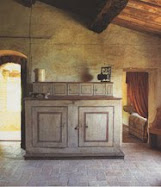
I just fell in love with Claire Basler’s studio/home when I opened the March 2010 issue of Elle Décor UK. An old iron works building on the outskirts of Paris houses this wonderfully talented artist. Claire’s love of flowers and her garden are certainly reflected in her work.

Being surrounded by so much natural light and having the subject you love to paint right at your fingertips sounds heavenly.

The colors mixed with the grays, the old and the new, the shiny and the textured… the combinations work.

Here it is! (All photos from Elle Décor UK, photos by Mads Mogensen)


A few of her paintings (courtesy of http://www.clairebasler.com/):


I love the silver and gold leaf backgrounds in these photos!


Sunday, April 4, 2010

Mariano Fortuny- Did you know he also painted?

When I think of Mariano Fortuny, lush velvets and delicate, pleated silks come to mind.  The “Delphos” dress is a classic. The “Fortuny lampshade” is also. The beautiful damask fabrics, the gorgeous clothes.  His mystique.  What I did not realize is that he was also a very gifted painter. And engraver. And stage and lighting set designer. Some of his inventions set new benchmarks in theater that are still followed today.


La Pedrera de Caixa Catalunya (the museum) in Barcelona, Spain is currently holding an exposition on Fortuny and his works: Fortuny, El mag de Venecia (Fortuny, The Magician of Venice).
Besides viewing his incredible fabrics, clothing and inventions, there are also presentations, discussions and a tactile tour of fabrics. I wish I was in Barcelona! I think they should bring this wonderful display to the USA!


Silk lampshades in Mariano Fortuny 1999 Marsilio Editori


Fortuny velvet


Mariano Fortuny (y Madrazo) was born in Grenada, Spain in 1871. After his painter father’s early death at age 36 of malaria in 1874, his mother moved her two young children to Paris, where Mariano was encouraged to study painting and etching under his uncle’s tuteledge. He was introduced to many of the artists at the time through his family and exposed to many styles of painting.   In 1889, his mother moved the family to Venice. Mariano spent time in both Venice and Paris, before finally settling in the Palazzo Orfei.  Today it is now called the Palazzo Fortuny, as it houses the museum dedicated to Fortuny and his works.

Here are some views of the Palazzo Fortuny:

Palazzo Fortuny exterior in Fortuny by Guillermo de Osma


Palazzo Fortuny exterior in Fortuny by Anne-Marie Deschodt


The Grand Salon in Fortuny by Anne-Marie Deschodt


The library in Fortuny by Anne-Marie Deschodt


Fortuny's studio in Fortuny by Anne-Marie Deschodt


Fortuny worked in oils, gouache and tempera, creating his own color pigments. He favored copper plate etching, which, along with his painting, greatly influenced his later creations in silk and velvet. He learned the subtle use of color and the importance of light to achieve the dramatic effects seen in his textiles.

Here are  some of Fortuny’s paintings:

Una roccia a pareti verticali sulla riva del mare" 1948


Prove alla Scala di Milano


Ritratto di Henriette Fortuny in costume pompeiano, 1935

Here Fortuny painted his own Palazzo:

Interno dell'atelier del pittore a palazzo Pesaro-Orfei a Venezia


http://www.invertirenarte.es/mercadodearte/imagenes/Octubre%2027/duran_fortuny.jpg
Painted by Fortuny's father, Mariano Fortuny Y Marsal (1835 - 1874)

And last, but not least, my favorite:

Schizzo per la decorazione dell'atelier dell'artista a Venezia

Friday, April 2, 2010

A few of my favorite things

Isn't this the cutest thing? When I saw this book, I knew I just had to use it as my Blog Book. It is my calendar of  "assignments," along with topic ideas and potential photos. (I cleaned it up a bit...)

My blog book


Although I don't remember where I found this photo, I hope to find these candlesticks some day. Anyone know where they are from?


Lately, I've been loving color combinations such as these. The door has a wonderful patina which looks like old lime paint. I love the teal and burgundy together.


I saw this ad last year and have been trying to decide where to try this color combo from Ligne Roset. It's not just the color combo, though. It is the lushness of the velvet in contrast with the aged roughness of the concrete.


Today's favorite things is going to become Friday's Favorites. I'd love to see what items and ideas my fellow bloggers love, too!

Monday, March 29, 2010

An Italian groin vault ceiling... in America

How can one pass up a week in a Tuscan villa? Located just inside of Umbria, an hour from Florence, this to-die-for villa was all you'd expect it to be. (Villa pics coming later.) With the villa serving as our base, we roamed the surrounding areas and just soaked it all in.

While traveling through Arezzo (east of Florence), we fell in love with these groin vaulted ceilings in a non-descript deli. We walked in for lunch, looked up and that was it! So typical of Italy- there is such beauty at every turn.

Arezzo, Italy groin vault ceiling

A few years ago, my SO opened a boutique/cafe that was based on our passion of Italian design. We blew up our video frames of the dome ceiling that we loved in Arezzo to see the pattern and attempted to re-create those designs.

I started out with m-a-n-y sample boards to figure out the finishes; here is one of the final boards- I think I finally figured it out!


Sample board


The groin vault domes (formed by the intersection of two or more barrel vaults) began with a custom engineered metal frame.

Drywall was affixed to the metal frame and the entire ceiling, especially the many seams, was smoothed, filled, sanded, followed by filling and sanding and filling and sanding. The plasterer (Thanks, Dan!) did an AWESOME job.


I first primed twice and basecoated twice before even thinking of the finish layers. Then I began applying the three plaster layers, using a custom mix for each layer. The first layer was ochre and lapis blue; the second and third layers were more of what you see- the whites and lapis blues.

Then we painted the designs, some freehand and some with a few specific designs cut in mylar to be consistent on site, trying to stay as close to the original ceiling design as possible.

Once the painting was complete, we added a layer of glaze to “knock back” and age the finish.

We only had 2 weeks to take the ceiling from the raw drywall and seams state to completion.

Still adding! These are the electrical guys for the chandelier installation.


Here we are at work...

The ceiling is 25 feet up there!

Adding details
Here is the beautiful Isola Bella groin vault ceiling, ready for the chandelier to be installed!

 
We're done! Just waiting for  the chandelier.

 
Closeup view of groin vault  seam

Friday, March 26, 2010

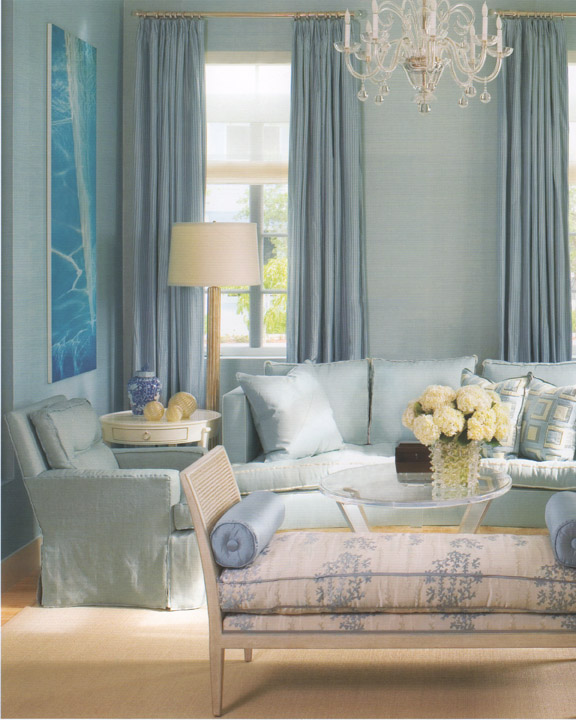
Monochrome

...as in the book, Monochrome, by Paula Rice Jackson. I thought I'd share some of my favorite photos from this quietly elegant book on one way to use color.

While I love color, especially how Mother Nature combines them, there is something soothing and exciting when you walk into a room and you just feel the balance and harmony of the subtle nuances of color.

The funny thing about using one color is that it takes just as much attention to detail as it does when using a range of colors.


Designer: Nancy Corzine


Designer: Vicente Wolf


Designer: Vicente Wolf


The marble wall is beautiful, wouldn't you agree?

Designer: John Saladino


The Venetian plaster walls in these photos are so...well, you just want to touch them! These monochrome walls are inspiring!

Designer: Philippe Starck


Designer: Philippe Starck

Wednesday, March 24, 2010

Go For the Gold... As In Gold Leaf

An elegant addition to any décor is to add the touch of gold or silver leaf to furniture or accessories. Whether accenting the special molding on a table or gilding a picture frame, the gold surface adds a special opulence and shimmer that cannot be replicated with metallic paint. When held up to the light, the sheet of gold leaf is so thin that it is semi-transparent. As a result, gilding should be done in a draft free environment. Any drafts of air will cause the leaf to literally blow away.

My own gilded table


My own renovated and gilded frame


Darnell Demilune Commode by Amy Howard in House Beautiful


Silver leaf table legs


There are two methods of gilding: oil gilding and water gilding. Oil gilding uses an oil size upon which, once it dries to a slight stickiness or “tack”, the gold leaf is gently laid on the surface and carefully pressed. Water gilding is a highly specialized craft used for applying gold on frames and furniture.

Create a screen like this with the fabulous stencils that are available now. An online search will bring up many stencil companies, such as Royal Design Studio or Cutting Edge Stencils.

Gilded screen Photographer: Erik Johnson


These arches were gilded with an oil size using Dutch (composite) leaf and sealed with Liberon wax.

Isola Bella gilded arches


Please join me again for Part two on gilding. I’ll explain the various types of gold leaf and offer reliable sources for supplies, books  and instruction. If you'd like any other facets of gold leaf gilding to be covered, please let me know.

Monday, March 22, 2010

A glossy ceiling? Really?

One of the widely followed home design maxims is to avoid the glossy ceiling. Flat paint it is! And most of the time, the ceiling is white (a totally different subject).

I would like to differ.  I love the shiny ceiling! The way it reflects the room and makes is seem more spacious. It amplifies the available light and gives the ceiling a much lighter feel.  The glossy effect can have a full range of finishes, from the imperfect to the mirror-smooth.

apartmenttherapy.com


However, it does need to be pointed out that a high gloss finish will highlight any flaws in the surface. If absolute perfection is important to you, then either go flat or first have a plasterer / finisher skimcoat the ceiling so that it's smooth. Then the painter (you?) can roll on the finish coats.

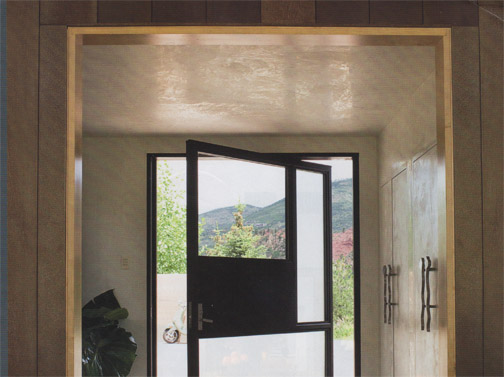
I happen to believe that the imperfect ceiling surface adds character! If you don’t mind a little waviness or imperfections, then a high gloss paint, a metallic paint, metallic leaf or Venetian plaster can add a beautiful shimmer to lift the room.

 
Elle Decor Photograph by Eric Piasecki


Elle Decor Photograph by Eric Piasecki


If you're going to use paint for as smooth a finish as possible, you should use a foam or short-napped roller and try to keep a wet edge. Coarse naps leave texture, and a dry edge can leave visible lap marks. If you use a metallic paint or metallic glaze, try the microfiber rollers for metallic paint. And add a paint “extender” for additional “open time” that allows you to roll on the paint with more ease and slows down the drying time.

These glossy ceilings are to die for:

Metropolitan Home, Larry Laslo Designs


Veranda magazine Photograph by Peter Vitale


Silver leaf ceiling: John Saladino- Style by Saladino